Knee pain can affect and limit people’s lives.
Initially, sufferers may feel a degree of discomfort when descending stairs.
This can then progress to avoidance of activities such as visiting a local
shop, difficulty rising from an armchair and even lying awake at night in
anticipation of pain subsiding.
Joint Replacement
surgery is often then discussed as a
solution where physiotherapy, drugs and behaviour modification are no longer
effective in alleviating symptoms.
Until recently, Bihar patients wishing to
benefit from innovative joint replacement surgery had to travel to Delhi,
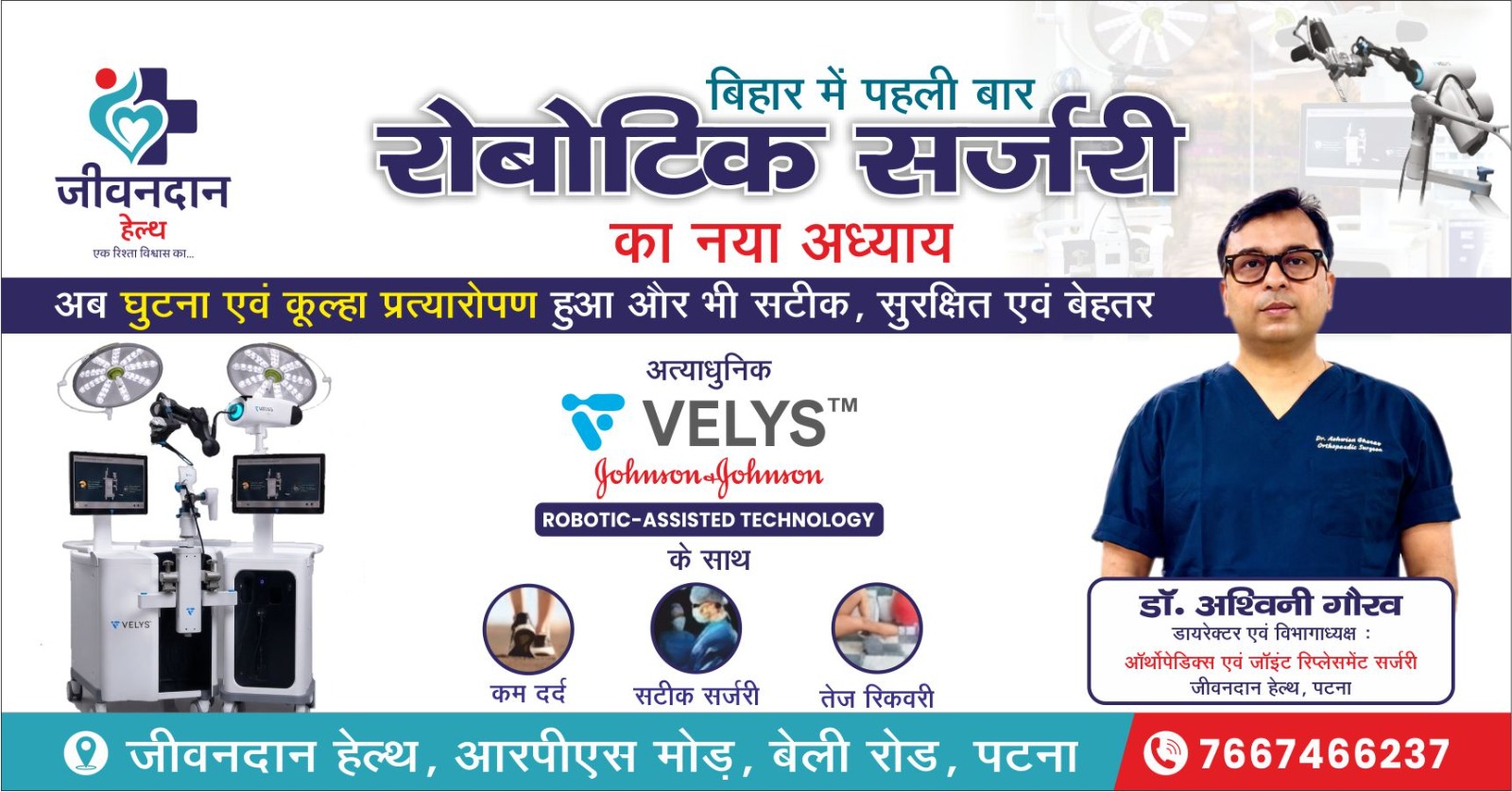
Kolkata and/or Mumbai. However, the implementation of robotic joint replacement
at Jeevandan Hospital means that people in Patna can now access the latest
orthopaedic surgery locally.
Below is
explained how robotic joint
replacement functions and its benefits.
a)
What is robotic joint replacement?
People often wrongly assume that a robot
conducts surgery.
However, the robot itself does not carry out
surgery. Rather it functions as both a computerised ‘satnav’ and an intelligent
instrument, which is fully operated by an orthopaedic surgeon.
Pre-Operatively - 3D modelling is used to
analyse a patient’s knee. This enables the surgeon to meticulously plan the
bone re-shaping and prosthesis fitting before surgery.
Operationally - The robotic arm is directed by
the surgeon to enact this pre-planned surgery. Throughout the operation, the
robot continually feeds back information and defines strict parameters so that
the cutting device never deviates from the defined area.
Whilst the robot supports and enhances the
surgery by providing additional control and accuracy, the surgeon is solely
responsible for clinical decisions. They manually assess soft tissue
equilibrium and control all movements. The robot is therefore a supplementary,
yet highly individualised, support.
Clearing Up Common Myths
|
Myth |
Reality |
|
The robot works on its own. |
The surgeon holds and controls the
instruments the entire time; the robot simply provides guidance boundaries
and digital tracking. |
|
Robotic surgery is dangerous or experimental. |
Robotic guidance is a thoroughly tested
advancement designed to reduce surgical error and preserve healthy bone and
tissue. |
|
You'll walk out completely healed the next
day. |
While precise alignment can encourage a
smoother recovery, bone and muscle still need time to heal. Rehabilitation
remains essential. |
|
It’s only for younger, active patients. |
Suitability depends on the severity of your
arthritis, bone health, and overall medical fitness—not your birth date. |
Should I consider knee joint replacement?
Although surgery is not usually the initial
option for patients, the majority are able to successfully control knee
problems for many years using exercise, diet and drugs. You may wish to discuss
joint replacement with an orthopaedic surgeon if you:
●
Have pain which
affects your sleep or everyday life
●
Observe noticeable
leg oedema, inflexibility and/or bowing
●
Are unable to walk
short distances or stand unaided
●
Do not gain
sufficient respite from drugs and/or physiotherapy
Following an initial analysis of your joint,
lifestyle aspirations and medical background, our top surgeon at Jeevandan
Hospital will advise whether joint replacement is suitable for you and whether
robotic surgery could provide added benefit.
What Does the Journey Look Like?
1. Analysis and 3D modelling
High specification imaging is initially
utilised to thoroughly analyse joint degeneration. Subsequently, bespoke
surgery can be planned.
2. Operation -
Working under the surgeon’s control, the robot is used to accurately excise
affected cartilage and bone. The prosthesis is then fitted with highly precise
millimetre accuracy.
3. Early mobilisation - For
the majority of patients, with the aid of gentle support, they are encouraged
to either stand or take short walks within 24 hours post operation. This is all
done under careful medical supervision.
4. Specific physiotherapy
- An active approach to recovery is key. Our expert physiotherapists support
you with exercises to improve equilibrium, mobility and self-assurance.
FAQ’S related to Joint Replacement surgery
1. How long will my recovery take?
As with all people, recovery rates differ
depending on age, previous level of fitness and adherence to exercise. Many
individuals are able to resume mild daily activity within a few weeks. Gradual
rebuilding of full muscle strength and energy usually takes a few months.
2. Is robotic surgery more costly?
As robotic surgery involves specialist computer
software, matrices and consumable items, it can be marginally more costly than
standard joint replacement. We value open and honest communication. From the
outset, our staff will clearly explain all elements of the cost including
admission, prosthesis type, anaesthetic and physiotherapy, so that your family
can easily budget for these aspects.
3. How long will my new joint last?
Contemporary knee prostheses are typically
designed to function effectively for 15-20 years and beyond. Correct
positioning of a prosthesis (a key benefit of robotic surgery) is also key to
minimising long-term differential wear.
High Quality Orthopaedic Care, Locally
Whilst the technology involved is an important factor in successful joint replacement, so too are the expertise of those undertaking the surgery, the hospital’s infection control procedures and post operative care.
By introducing robotic joint replacement, Jeevandan
Hospital is working to ensure that people in Patna can benefit from
state-of-the art orthopaedic surgery. Patients avoid the physical, emotional
and financial burden that would be incurred by having to travel out of state
for treatment.
If you feel that knee pain is adversely
affecting your life then please arrange an appointment with the Orthopaedics
& Joint Replacement team at Jeevandan Hospital, Patna .
The Real Cost of Traveling for Treatment
Typically, when Bihar families require major
surgery they have sought to travel to Delhi or Kolkata. However, travelling,
particularly when experiencing significant joint pain, is itself extremely
tiring. Furthermore, queuing to board trains, then having to sit for long
periods with an aching and inflexible knee, and subsequently residing in
foreign guest houses all add substantial physical and emotional burdens.
Logistically, it is also far from convenient to
catch an all-night train to consult the operating surgeon should a minor issue
or enquiry arise three weeks after surgery for example.
Providing robotic joint replacement locally in
Patna means that people can recover in the comfort of their own home, eating
favourite foods and being surrounded by family members who do not need to
disrupt their own lives by relocating many hundreds of kilometres away. Local
care also facilitates effortless monitoring of a patient’s progress,
examination of their wound and continuation of physiotherapy, all under the
immediate supervision of those who carried out the original surgery.
A Partnership Built on Your Goals
Whilst ideal prosthesis positioning, as viewed
on X-ray, is an important criterion for a successful joint replacement, so too
is what someone is able to achieve 6 months post-surgery.
Whether this involves free participation in a
family wedding (without the need for a wheelchair), leisurely evening rambling
along the Ganga, or simple pain-free floor play with grandchildren, it is
technology which enables people to strive towards these aims. Nevertheless, it
is the orthopaedic expertise, specialised physiotherapy and personal dedication
to recovery which truly effect change.
Chronic, creaking joint pain does not have to
become synonymous with later life. Should you be prepared to investigate what
it is like to once again move about unencumbered, we are here to listen, advise
and support you along the way.
Jeevandan Hospital
Metro Piller no. 140, B. No - 3313, Bailey Rd,
next to indian oil petrol pump, RPS More, Kaliket Nagar, Patna, Bihar 801503
Tel- 76674 66237